
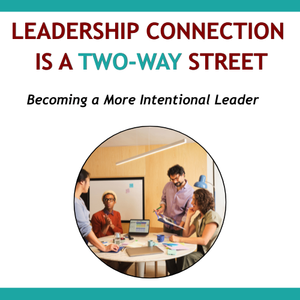
When leadership teams discuss employee engagement, the conversation often centers on how leaders can better connect with employees. We talk about asking questions, showing interest, conducting check-ins, and learning more about team members as individuals.
Those actions matter.
But another side of the equation gets far less attention: employees want to connect with their leaders too.
Too often, leaders believe promotion requires distance. They become more reserved, more guarded, and more focused on maintaining separation from their teams. While usually well-intentioned, that distance can make it harder for employees to develop trust and connection.
Employees are naturally curious about the people who lead them. They want to understand who their leaders are, what they value, how they think, and how they navigate challenges. Employees can only gain those insights if leaders are willing to share.
Connection, after all, is a two-way street.
Your Team Is Watching
In my leadership workshops, I often share what I learned from my own journey: leaders are all celebrities. Not in the traditional sense, of course. But within their teams, people are paying attention.
Employees watch how leaders react under pressure. They observe what gets celebrated, what gets ignored, what earns recognition, and how difficult situations are handled. They're also trying to understand what their leaders think about organizational changes, business challenges, and future direction.
If leaders don't provide that information directly, employees will often fill in the blanks themselves.
Unfortunately, assumptions rarely strengthen trust. Transparency does.
That doesn't mean leaders need to share every personal detail of their lives. It does mean sharing enough that employees can see the human behind the title.
Where did you go on vacation? How to you balance work and life. If all they see is you working all the time, they may interpret that to be the expectation for themselves.
- How do you manage stress?
- What challenges are keeping you up at night?
- How are you feeling about the current economic environment?
These conversations help employees connect to the leader as a person, not just a position.
Vulnerability Doesn't Lower Standards
Many leaders worry that being more open will somehow diminish their credibility or authority.
In my experience, the opposite is often true.
Early in my career, I worked for the North American leader of a global organization. He was one of the most respected leaders I've ever encountered, and much of that respect stemmed from his authenticity.
There were times when he disagreed with aspects of the global strategy. Rather than pretending complete alignment at every stage, he was transparent about his frustrations and concerns with his leadership team. At the same time, he modeled something equally important.
He showed us that it is possible to disagree without becoming disengaged.
He created an environment where differing opinions were welcomed, healthy debate was encouraged, and people felt psychologically safe expressing their perspectives. Yet once decisions were made, he was equally clear that our responsibility was to commit to the direction and execute successfully.
His openness didn't undermine confidence.
It strengthened trust.
The leadership lesson wasn't that frustration is acceptable. It was that frustration is human. What matters is how leaders guide themselves and their teams forward.
That region ultimately became the most successful region in the organization.
The experience taught me that vulnerability is not about lowering expectations. Leaders can be both authentic and accountable. In fact, the best leaders often are.
What Happens When Leaders Create Too Much Distance
I've also seen the opposite happen.
One leader I coached was under significant pressure to deliver results. As deadlines increased and expectations mounted, the focus gradually shifted from people to tasks.
The team's primary opportunity to interact with the leader was through quarterly meetings with tightly structured agendas. Operationally, nothing appeared wrong.
Relationally, however, cracks began to emerge.
The first sign was that informal leaders started filling the connection void. Employees naturally sought out people who were accessible, relatable, and willing to listen. While these informal leaders provided needed support, they also began carrying much of the influence that should have belonged to the formal leader.
The second consequence was subtler but equally important.
Employees began feeling managed rather than led.
Interactions felt like status updates rather than conversations. They felt checked on instead of valued. Over time, people became less empowered because the relationship had become centered on deliverables instead of people.
Connection cannot be built solely through agendas.
Employees want to know that leaders care about their work, but they also want to know that leaders care about them.
Connection Is Not a Check-the-Box Activity
One of the biggest misconceptions in leadership is that connection can be scheduled once and considered complete.
A quarterly lunch isn't connection. A town hall isn't connection. A team-building event isn't connection.
Connection is built through consistent interactions over time.
Leaders with strong emotional intelligence recognize that employees connect differently. Some enjoy group settings. Others prefer one-on-one conversations. Some are comfortable sharing openly, while others need time to build trust.
The leader's responsibility is not to determine the format that works best for them. The leader's responsibility is to meet people where they are.
Share Your Story Without Stealing the Spotlight
As leaders become more intentional about building connections, I occasionally see them overcorrect.
After hearing advice about active listening, they become so focused on asking questions that they stop sharing about themselves altogether. That's not the answer either.
Employees want to know their leaders.
They want to understand your experiences, your values, your challenges, and what has shaped your perspective. Sharing those things helps build trust and creates common ground. The key is knowing when and how to share.
One communication concept I often discuss with leaders is avoiding "topper" conversations.
A topper conversation occurs when someone shares something meaningful, and the response immediately shifts attention back to the other person. An employee mentions a vacation, and the leader responds with a bigger vacation story. An employee shares a recent accomplishment, and the leader follows with an even larger accomplishment of their own.
While rarely intentional, the result is often the same: the employee feels less heard, and the conversation becomes centered on the leader.
Instead, I encourage leaders to keep it simple: connect before you relate.
If an employee shares an exciting trip, stay curious about their experience first.
What was their favorite part? Was there something that surprised them? Would they go back?
Allow them space to fully tell their story and feel seen.
Then, once you've connected with their experience, share your own. At that point, your story isn't competing for attention. It builds on the connection you've already created.
The purpose of sharing your experiences should be to deepen the relationship, not reclaim the spotlight.
The best leaders know how to do both. They listen with genuine curiosity, and they share with genuine authenticity. Employees leave those conversations feeling heard while also learning something new about the person leading them.
That's where meaningful connection happens. Not when one person talks and the other listens, but when both people have the opportunity to know and be known.
Practical Ways to Strengthen Connection
Meaningful connection doesn't require elaborate programs. Small, intentional actions often make the biggest difference.
Consider:
• Holding regular skip-level meetings to build relationships beyond your direct reports.
• Beginning meetings with a quick personal check-in before discussing work.
• Asking employees to rate their energy level on a scale of 1-5 to create space for meaningful dialogue.
• Sharing personal experiences that help employees understand your perspectives and values.
• Making time for informal conversations that aren't tied to performance updates or project status.
These moments send a simple but powerful message:
You matter as a person, not just as an employee.
The Lasting Impact of Connection
I once had the opportunity to spend ninety minutes over lunch with the global president of a business unit who was at least four levels above my role.
It wasn't a strategy session. It wasn't a performance review. It was simply a conversation.
By the end of that lunch, I felt more connected to the organization's purpose and more committed to its success than I had before walking into the room.
The leader's title didn't create that impact.
The connection did.
And that's the lesson for all leaders.
Employees don't expect perfection. They don't expect leaders to have all the answers. What they do want is to know the person behind the position.
The strongest leaders take time to understand their people.
The most trusted leaders also allow their people to understand them.
Because leadership connection isn't a one-way street.
It's a relationship. And relationships require effort from both directions.